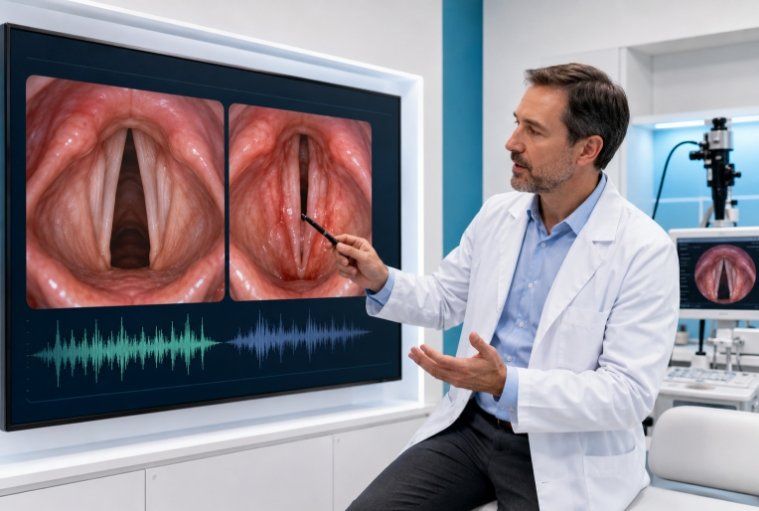
Persistent hoarseness, breathiness, or raspiness lasting longer than 14 days without an active cold or respiratory infection.
A raw, aching, or burning pain in the throat during or immediately after speaking.
A constant feeling of a "lump in the throat" (globus sensation) that does not clear with swallowing, often an indicator of silent reflux.
Complete, sudden loss of voice (aphonia) without an obvious respiratory illness.
FAMILY COUNSELING & SUPPORT SERVICES
Reflux & Environment Mapping: Identifying dietary patterns (heavy tea, coffee, late meals) and environmental dust exposure that may cause chronic vocal fold inflammation.
Vocal Hygiene Pacing: Advising on customized hydration schedules and strategies to eliminate aggressive, damaging throat-clearing habits.
Professional Voice Coaching: Providing tailored breath and resonance guidance for MENA professionals, including teachers, call center staff, and public speakers, to prevent vocal fatigue.
Immediate coughing, choking, or throat-clearing during or right after swallowing liquids or solid foods.
A "wet" or gurgling voice quality immediately after eating or drinking, indicating food/liquid may be resting on the vocal cords.
Food consistently getting stuck in the throat or traveling backward into the nasal passage.
Unexplained weight loss combined with a newly developed fear of eating or drinking (phagophobia).
FAMILY COUNSELING & SUPPORT SERVICES
Adherence to Global Texture Standards (IDDSI): Educating families on safely modifying food and liquid consistencies according to international IDDSI standards to prevent airway penetration and choking.
Postural & Environmental Strategies: Counseling on the biomechanics of safe swallowing, maintaining a 90-degree upright seating posture during meals and 30-45 minutes post-meal.
Vigilant Oral Care Protocols: Emphasizing rigorous daily oral hygiene to keep the mouth bacteria-free, preventing aspiration pneumonia in dysphagic adults.
Meal Pacing and Bolus Control: Advising on safe feeding techniques, controlling bite sizes, pacing meals, and alternating solids and liquids.
Psychological Support & Mealtime Dignity: Providing strategies to reduce mealtime anxiety (phagophobia) and adapting dining traditions so individuals remain safely included.
Recognizing Aspiration Red Flags: Training caregivers to monitor for subtle clinical signs of unsafe swallowing, such as a wet vocal quality post-swallow and low-grade fevers.
Sudden onset of slurred, muffled, or dragging speech (requires immediate emergency medical screening for stroke/CVA).
Gradual, progressive decline in speech clarity over months (a strong indicator requiring screening for neurological conditions like Parkinson's).
Visible facial drooping, continuous drooling, or loss of motor control over the tongue and lips.
FAMILY COUNSELING & SUPPORT SERVICES
Intelligibility Optimization: Advising on pacing, over-articulation, and syllable-timed phrasing to help the individual make practical, daily speech modifications.
Family Communication Environment Setup: Coaching relatives on reducing ambient background noise and maximizing face-to-face communication habits to aid mutual understanding.
AAC (Augmentative Communication) Advisory: Guiding families toward mobile apps and picture communication boards to lower the individual's daily frustration.
Sudden word-finding difficulty (anomia), completely misnaming common household objects, or speaking only in fragmented, broken sentences.
Abrupt loss of comprehension, where the individual suddenly cannot follow basic spoken instructions or loses the ability to read and write.
Fluent but meaningless speech (jargon aphasia), where the person speaks confidently but uses unrecognized words and is unaware of their communication errors.
Sudden changes in cognitive alertness, confusion, or new facial drooping, which require emergency neurological screening to rule out a secondary stroke.
COMPREHENSIVE FAMILY COUNSELING & STROKE SUPPORT SERVICES
Supported Conversation Strategies: Educating families on how to bridge the communication gap using multimodal techniques, including hand gestures, visual communication boards, and binary (yes/no) questioning to reduce daily frustration.
Neuroplasticity & Expectation Management: Providing scientific counseling on brain healing, spontaneous stroke recovery timelines, and setting realistic, milestone-based communication goals for the family.
Home Environment Integration: Guiding caregivers on how to embed cognitive-communication practice into daily routines. We advise on using familiar triggers like family photo albums, favorite music, and household tasks to naturally stimulate language recovery.
Caregiver Burnout & Emotional Support: Offering empathetic guidance on managing the emotional toll of stroke. We equip families with strategies to handle the patient's emotional lability, frustration, and behavioral changes, fostering a supportive home environment.
Speech blocks or stuttering that lead to severe social isolation, clinical depression, or avoidance of career advancements.
Physical tension patterns while speaking, including severe eye blinking, jaw locking, or overall body tensing to force words out.
Sudden onset of stuttering in adulthood without any prior childhood history (a red flag indicating an urgent neurological screen is needed).
FAMILY COUNSELING & SUPPORT SERVICES
Psychological Desensitization: Providing counseling to lower communication anxiety and challenge the social stigma surrounding stuttering within regional cultural settings.
Speech Modification Practice Checkpoints: Offering online advisory feedback on speech techniques such as easy vocal onsets and prolonged speech patterns.
Workplace & Academic Self-Advocacy: Equipping individuals with strategic presentation skills to confidently manage corporate meetings, phone calls, or public presentations.